
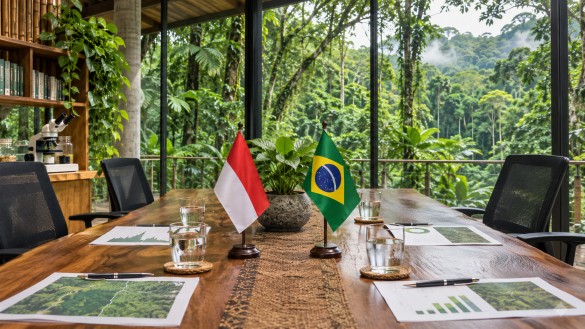
Indonesia and Brazil are actively pursuing a partnership focused on tropical forest conservation and carbon financing, as highlighted during discussions at the 31st UN Climate Change Conference (COP31) in Antalya, Türkiye. This collaboration aims to enhance sustainable forest management and improve the livelihoods of communities reliant on forest resources in both countries.
The talks centered on exchanging knowledge and developing strategies that align environmental protection with community development. Indonesian representatives expressed interest in Brazil’s successful initiatives in the Amazon region, which integrate forest conservation with essential services such as clean water, solar energy, internet access, and food security.
One significant aspect of the potential partnership is exploring the Amazon Fund as a model for conservation financing. This fund utilizes international support and results-based funding to bolster conservation efforts. Additionally, Brazil’s carbon credit certification system, Ecora, was discussed as a method to enhance the credibility of carbon credits through scientific methods and transparent governance.
Indonesia is keen to learn from these approaches to fortify its own carbon certification framework, contributing to its Forestry and Other Land Use (FOLU) Net Sink 2030 target. This goal is part of broader efforts that include social forestry and ecosystem restoration programs.
Both nations are considering technical cooperation across various sectors, including government agencies, universities, and civil society organizations. Plans are underway to prepare a joint white paper on partnership opportunities and to organize a technical workshop in the coming years.
The proposed collaboration between Indonesia and Brazil seeks to not only protect tropical forests but also improve transparency in carbon markets, attract conservation investments, and support economic development for forest-dependent communities.